Trapani: Where Time Slows on the Edge of Sicily


If Sicily writes love letters, then Trapani’s inbox would be overflowing with every line penned in sea salt and sunsets. Trapani isn’t just a place you see. It’s a pace you feel.
I was on my last trip with my son before he leaves for college, joined by my cousin from Turin. He and I wanted to tour an olive grove for possible business opportunities, and Lorenzo tagged along to see Sicily. This was my first time in Sicily, and now I believe it when people say that it’s completely different from the rest of Italy.

Trapani is a little port town on the island’s western edge that doesn’t rush and allows a native Californian to have an out-of-body experience. Life here moves with the tide and is unbothered by the idea of time. So much so that most of the drive from the airport to the hotel looked abandoned. It’s not like the rest of Italy’s villages and cities, with people walking all over; in fact, I didn’t see any people. The drive to the hotel was uneventful, and my cousin from Turin turned to me and asked if I could ever see myself living in a place like this. It’s quieter than Tuscany, to give you a visual.
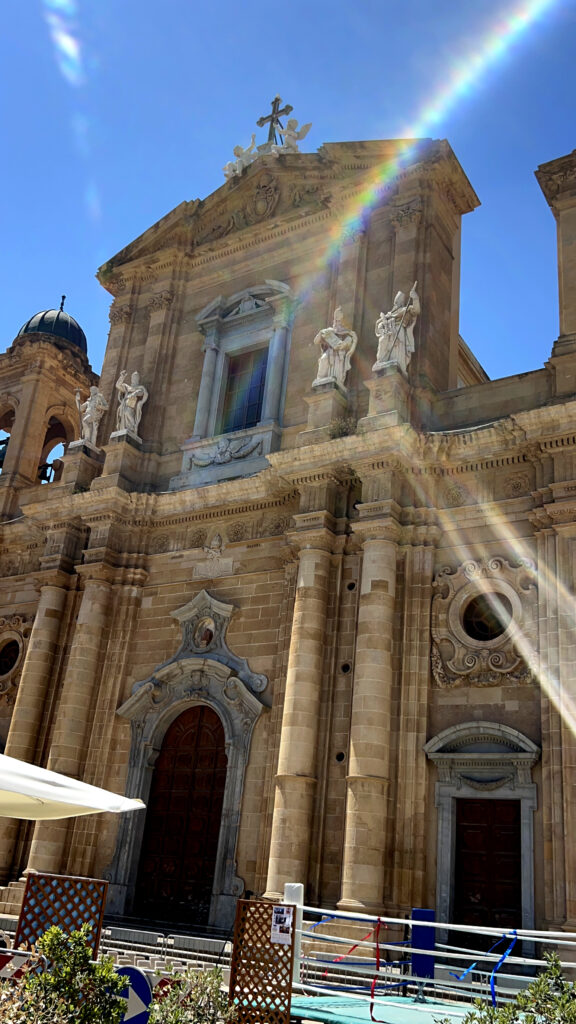
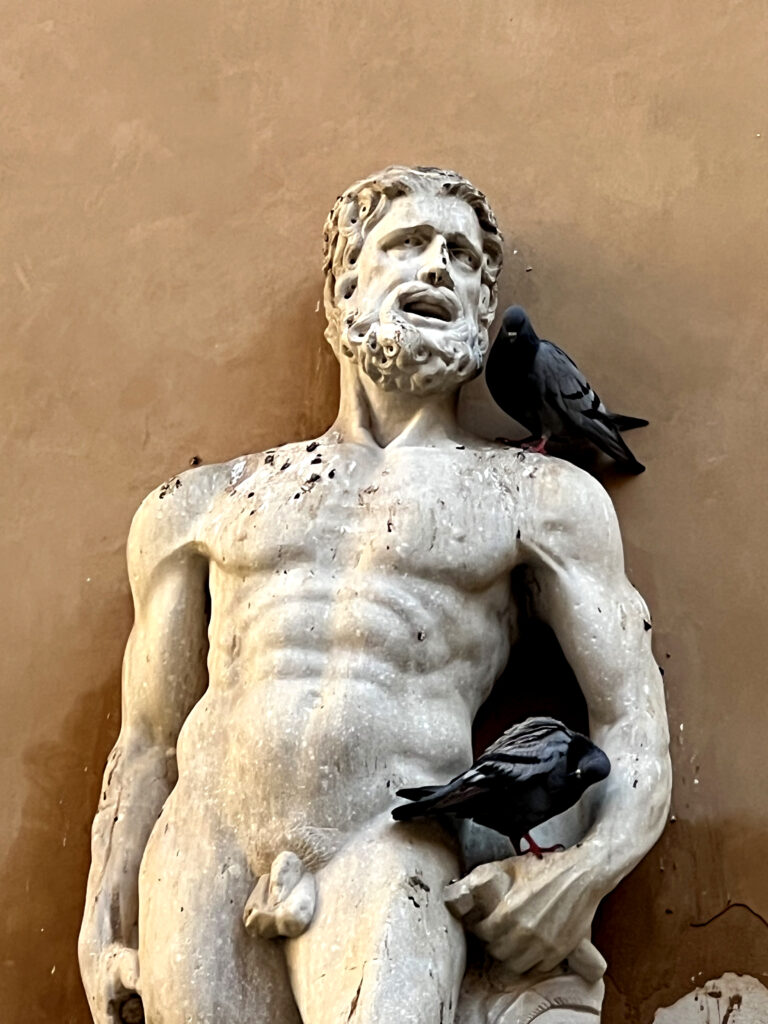
After we checked into the hotel, we went to the city center, and there I finally saw some life. Statues stood guard over piazzas, and bookstores had their doors flung open as if inviting you in. The thick summer humidity coated my skin like a sauna. My hair stayed frizzed, and my lips cracked as we strolled through the city center until reaching the Cathedral of San Lorenzo. Its sandstone façade glowed golden in the late afternoon. A rainbow shot across the church, as if heaven had decided to photobomb the moment. That’s Trapani: slowing you down just long enough to catch its unexpected miracles.
Trapani is a place you wander. You linger. And the locals stare at you, knowing you’re an outsider. You sit by the sea longer than you meant to because the air smells like salt and jasmine, and for once, your to-do list doesn’t stand a chance.
Friends who I have back in the States told their parents, who were locals, that we were in town, and they asked to meet up. Did I know them well? Not at all. Did that matter? Not one bit. That’s the Italian way. Hospitality flows by association; if you’re even loosely connected, you’re family. One aperitivo turns into two, stories are swapped, and translations are pieced together, trying to form a connection.
That evening, we took a trip to Erice, Trapani’s secret twin, perched high above the sea. You drive into the clouds, and your heart stops on the winding roads. The temperature drops, the air turns crisp, and suddenly you’re wrapped in a cool breeze that feels like a relief after Trapani’s warm coastal sun. The cobblestone streets twist like a web, lined with medieval walls, archways, and quiet courtyards. Cats nap in doorways as if they own the place (and honestly, they do). Walking in Erice feels like stepping back in time; it is an otherworldly experience. While Trapani hums at sea level, Erice whispers. The silence feels old, sacred, as though every stone has been keeping secrets for centuries.
The skies perform in slow motion. The sun doesn’t just dip into the sea; it lingers, stretching pinks and golds across the horizon. From Erice, the view is something else entirely, with the coastline of western Sicily sprawled beneath you, fading into lavender as bells chime in the distance. Our dinner lasted hours, and we left Erice a little buzzed, wandering through dark alleys in a place that makes you feel as though you’re part of a film.
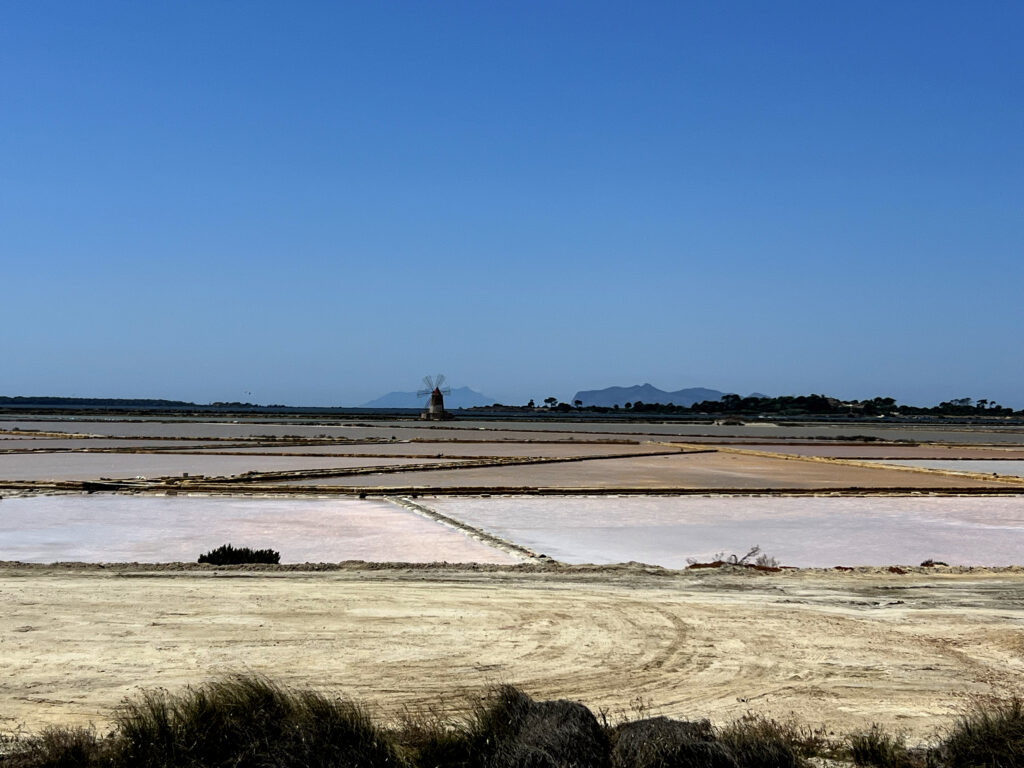
The next day, we took a day trip to Favignana. The day after, we departed for Turin for a family lunch. On the way to the airport, the famous salt flats stretched out like giant mirrors under the Sicilian sun. White mounds glowed in the distance while ancient windmills creaked lazily in the breeze. Salt is still harvested here by hand, with steady, intentional care. The kind of work that allows you to respect nature. All while passing a thousand windsurfers. Their colorful kites whipped and danced like confetti across the sky, somehow perfectly in rhythm with Trapani’s slow wind.
In Trapani, you eat slower, you walk slower, you notice more. And when you leave, you carry that rhythm home with you. I don’t know if I’ll ever return, but this much I know: I’m grateful I experienced it. Because Trapani taught me that the best moments aren’t rushed; they’re the ones that unfold slowly, softly, like the tide.
🌿 🌿 🌿
Travel Insights for Trapani
When I think back on Trapani, I realize it’s not really a destination. It’s a feeling. And if you’re planning a trip here, the best advice I can give is this: don’t try to do too much. Trapani reveals itself slowly. The more you rush, the more you’ll miss.
Don’t Rush the Salt Flats
The salt flats were one of the last things I saw before leaving Trapani, and I’m glad they were. White mounds glowed beneath the Sicilian sun while ancient windmills stood watch over the landscape. It felt less like a tourist attraction and more like a reminder that some things still happen slowly.
Salt is harvested by hand here, the same way it has been for generations. Looking out across the water, I couldn’t help but think how different it felt from home. No one seemed to be rushing. Not the workers. Not the wind. Not even the landscape itself.
If you’re visiting, don’t treat the salt flats as a quick photo stop. Give yourself time to stand there and take it all in.
Wander Without a Plan
One of my favorite parts of Trapani was simply walking. The historic center isn’t huge, which means you can let yourself get a little lost without worrying.
Put away your phone. Turn a corner because it looks interesting. Step inside a bookstore. Sit in a piazza longer than you planned. Some of my favorite moments happened when I wasn’t looking for anything at all.
Trapani rewards curiosity.
Meals Are Events Here
One thing I noticed in Trapani is that nobody seems interested in rushing through a meal. Lunch stretches into the afternoon. Conversations wander. Another bottle appears. Dessert arrives whether you planned on eating it or not.
I found myself paying more attention to food than I normally do. Maybe it was the pace. Maybe it was the company. Whatever the reason, I could taste every ingredient.
If you go, try the couscous al pesce. Sicily’s history is reflected in the dish, blending North African influences with local seafood traditions. Busiate with pesto Trapanese is another must. Made with almonds, tomatoes, garlic, and basil, it tastes distinctly Sicilian.
More than any particular dish, though, pay attention to the experience. In Trapani, meals are about belonging as much as eating.
Make Time for Aperitivo
Some of my favorite memories from Italy happen during aperitivo, and Trapani was no exception.
Find a spot near the water around sunset. Order a spritz or a glass of local wine and simply sit. Watch the sky change colors. Listen to conversations around you. Let the evening unfold on its own.
If you’re lucky, one drink turns into two, and a simple stop before dinner becomes one of your favorite memories from the trip.
Visit Erice
If Trapani hums, Erice whispers.
Perched high above the sea, Erice feels like stepping into another world. The air is cooler. The streets are quieter. Stone pathways twist between medieval buildings and hidden courtyards.
Take your time there. Wander. Stop for a pastry. Look out over the coastline below.
The views are beautiful, but what stayed with me most was the feeling. Erice feels old in the best possible way, as though every stone has a story to tell.
Take a Ferry to the Egadi Islands
If you have extra time, take a ferry to one of the Egadi Islands.
We spent a day in Favignana, and it ended up being one of the highlights of the trip. The water looked almost unreal, shifting between shades of blue that seemed impossible.
Each island has its own personality, but they all share the same slower rhythm that makes western Sicily so special.
Leave Room for Surprise
Some of my favorite memories from Trapani weren’t planned.
A rainbow crossing the Cathedral of San Lorenzo.
Cats sleeping in medieval alleyways.
The sky filled with colorful windsurfers on the morning I left.
Those moments couldn’t be scheduled, and that’s exactly why they mattered.
Leave space in your itinerary. The best parts of Trapani often arrive when you’re not looking for them.
Foods Trapani Is Known For
Couscous al Pesce
If Trapani has one signature dish, this is it. Influenced by centuries of cultural exchange across the Mediterranean, couscous al pesce combines fluffy couscous with a rich seafood broth. It’s comforting, flavorful, and distinctly Sicilian.
Busiate Pasta
Busiate is a twisted pasta shape that seems designed to hold onto every bit of sauce. You’ll find it served with seafood, but it’s especially famous with pesto alla Trapanese.
Pesto alla Trapanese
Unlike the pesto found in northern Italy, this version combines almonds, tomatoes, garlic, basil, and olive oil. The result is fresh, slightly sweet, and perfect with busiate pasta.
Pane Cunzato
Sometimes the simplest foods are the most memorable. Pane cunzato is bread topped with tomatoes, anchovies, cheese, oregano, and olive oil. It’s humble, satisfying, and completely Sicilian.
Tuna
The sea has shaped Trapani for centuries, and tuna appears everywhere. Grilled, seared, preserved in olive oil, or folded into pasta, it’s one of the ingredients most closely tied to the region.
Gamberi Rossi di Mazara
These famous red shrimp come from nearby Mazara del Vallo. Sweet, delicate, and often served raw with little more than olive oil and lemon, they’re considered some of the finest shrimp in Italy.
Arancine
Golden and crispy on the outside, soft and savory on the inside, arancine are one of Sicily’s most beloved street foods. They’re the perfect snack while wandering through town.
Panelle
Made from chickpea flour and fried until crisp, panelle are simple but incredibly satisfying. They’re often served inside bread and are a local favorite.
Cassatelle di Ricotta
These fried pastries filled with sweet ricotta and chocolate are impossible to forget. Warm, crispy, and just sweet enough, they’re worth seeking out.
Genovesi Ericine
If you visit Erice, order a genovese. Filled with custard cream and dusted with powdered sugar, it’s the pastry most associated with the hilltop town.
Cannoli Siciliani
No trip to Sicily feels complete without a cannolo. Crisp shells filled with sweet ricotta are a classic for a reason.
Granita al Limone
On a hot Sicilian morning, few things are more refreshing than lemon granita. Cold, bright, and intensely flavorful, it’s one of the simplest pleasures you’ll find in Sicily.
Marsala Wine
Produced just outside Trapani, Marsala wine has been part of western Sicily’s identity for centuries. Enjoying a glass after dinner feels like the perfect way to end the day.
Final Thoughts
Trapani is the kind of place that lingers long after you leave, not because you checked sights off a list, but because it slows you down enough to notice what matters. It’s in the quiet of Erice’s stone streets, the shimmer of the salt flats at sunset, and the laughter around a table where couscous al pesce or busiate are shared without hurry.
It’s a rhythm, softer and steadier, that seeps into you with every bite, every stroll, and every salty breeze. I carried that rhythm home with me, tucked between photographs and memories, a reminder that life’s richest moments aren’t found in rushing, but in savoring.