
How to Make Butternut Squash Risotto the Italian Way (Risotto alla Zucca)
I love butternut squash riscotto!
And I love fall! I mean really, who doesn’t?
It’s that magical in-between season where you can wear your favorite sweater without sweating through it — it’s not too hot, not too cold — it’s like Goldilocks said just right.
The air feels crisp, your coffee tastes fancier, and suddenly you’re convinced you’re the kind of person who forages mushrooms or goes apple picking “just because.”
And when it rains? Game. Over. I’m curling up with a good book, pouring myself a glass of wine, and cooking sometime that will smell up the house, and turning on my classical music like I live in some romantic Italian villa.
The windows fog up, the candles flicker, and the whole place smells like amber, vanilla, and freshly roasted coffee beans. There’s something about fall that makes me feel like I’m the main character in a European movie — one where nothing really happens except slow walks, soulful eye contact, and perfect lighting.
Fall is basically my soul’s season. I want to live inside a bowl of roasted squash and freshly baked focaccia. I want to wear oversized sweaters and pretend I understand wine notes (“Ah yes, very…grapey.”). I want to have long, moody thoughts about life while stirring a pot of something aromatic and important.
But here’s the thing — in Italy, fall doesn’t smell like cinnamon. It smells like sage crackling in olive oil.
Let that sink in for a second.
Not “pumpkin spice everything” or a candle called “Autumn Flannel Latte.” No, no. The Italians keep it earthy, savory, and confident. It smells like garlic softening in the pan, like roasted chestnuts on a street corner, like life slowing down on purpose.
Cinnamon could never.
In Italy, no one’s racing to find the first pumpkin spice latte of the season — because they’re too busy roasting real pumpkin. And by pumpkin, I mean zucca — the Italian word that covers everything from pumpkin to butternut squash. The kind of squash that turns into silky soups, velvety purées, or my personal favorite — risotto.
Walk through an Italian market in October and you’ll see it all laid out like art: piles of golden zucca stacked next to bundles of fresh sage tied with twine. The air smells faintly sweet from chestnuts roasting, and the chatter around you is soft and warm. Someone’s nonna is negotiating over pears. Someone’s nonno is sampling olive oil like it’s fine wine. Everyone moves slower, like they’re in sync with the season.
Fall in Italy isn’t about rushing to “get cozy.” It’s about being cozy already.
You feel it in the way the air hangs heavy with the scent of rain and rosemary, in how Sunday lunches stretch into early evening, and in the quiet pride of a simmering pot that needs no explanation.
And if there’s one dish that captures that exact feeling — the warmth, the patience, the elegance in simplicity — it’s risotto alla zucca, or as we know it, Butternut Squash Risotto.
This is not a “set it and forget it” kind of meal. No, this one asks for your attention. It asks you to slow down, to stir gently, to pour yourself a little wine while you cook (you know, for “quality control”). It’s fall, Italian style — simple, sensual, and worth every single minute you give it.
A Little Kitchen Therapy
Here’s what I love most about Butternut Squash Risotto: you can’t rush it. You physically can’t. The rice will take its sweet time to absorb the broth no matter how many emails you’re ignoring. So you may as well surrender.
Put on some Andrea Bocelli, pour yourself that glass of white wine, and let the world slow down for twenty minutes. The stove hums, the olive oil glistens, and that first waft of sage hits — suddenly, everything else fades away.
There’s something meditative about stirring risotto. You’re watching simple ingredients — rice, broth, squash, herbs — come together to become something far greater than the sum of their parts. Like life, or relationships, or a good skincare routine — it’s all about layering and patience.
How I Serve Butternut Squash Risotto
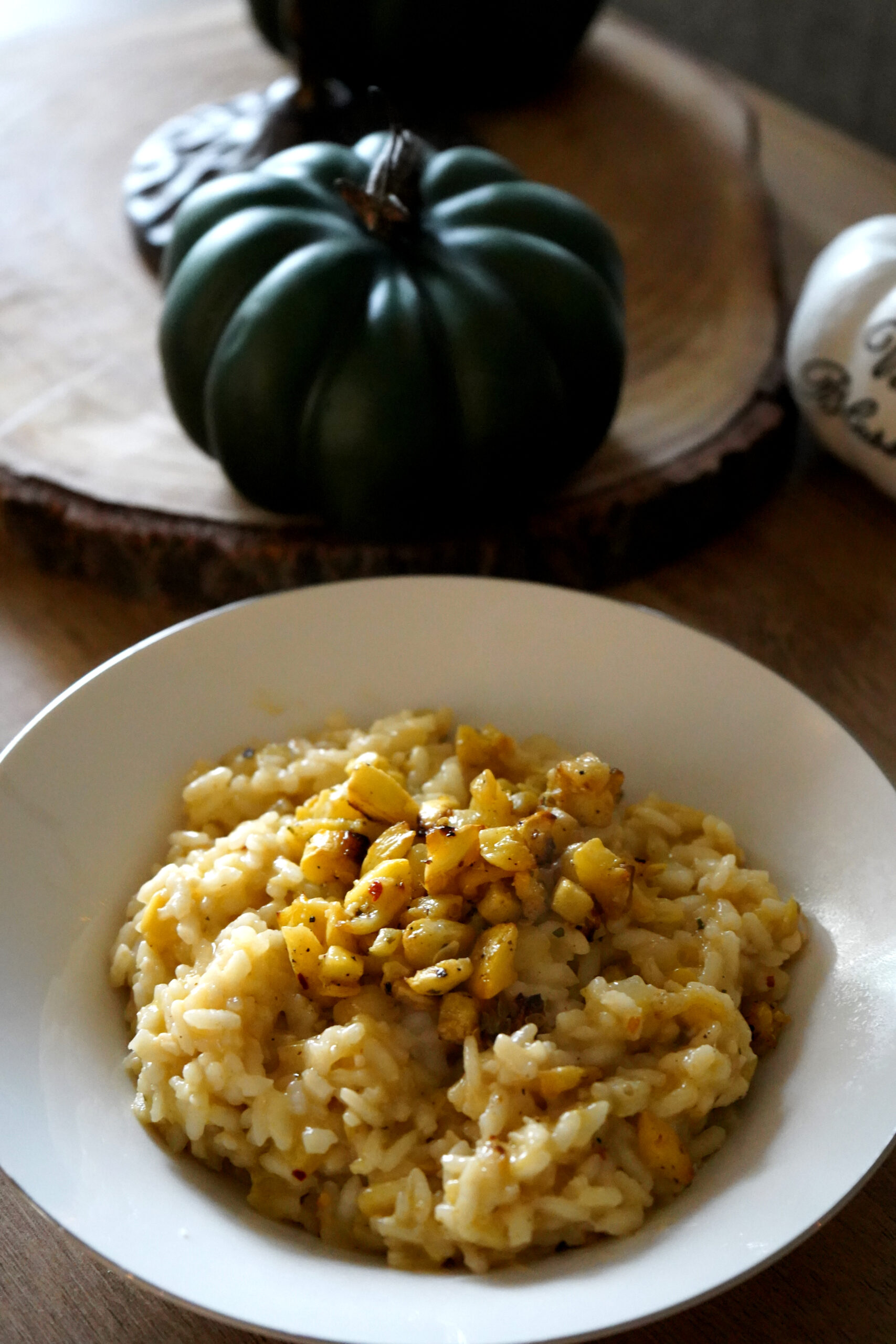
When I make this Butternut Squash Risotto, I go all in on the presentation. I ladle it into shallow bowls, let it settle just enough to show off that glossy, velvety texture, then top it with crispy sage and a drizzle of peppery olive oil.
Sometimes I’ll add roasted squash cubes on top — the caramelized edges give a little bite against the creaminess. If I’m feeling fancy, I’ll break out my truffle oil for that rich, earthy finish that makes people go, “Wait, what’s in this?”
I love serving it with a crisp white wine — something like Verdicchio or Greco di Tufo. (Basically, if it sounds Italian and pairs well with fall vibes, it’s perfect.)
And if you’re a bread-dunker? Grab that crusty sourdough and go for it. Because carbs were meant to love each other.
Setting the Mood for Butternut Squash Risotto
To really capture the Mediterranean fall mood, I like to dim the lights and add candles — preferably the unscented kind so the risotto can be the star of the show. I’ll put on my “Italian Café” playlist, pretend my kitchen window overlooks the Amalfi Coast, and eat like I’ve earned a Michelin star.
Because why not romanticize your own dinner? Italians do it every day.
A Little Note on Olive Oil
If you’ve followed me for a while, you know this part matters. Olive oil isn’t just an ingredient — it’s an experience. For this dish, go for a robust, cold-pressed extra virgin olive oil. Something with peppery notes that can hold up to the richness of the risotto.
My go-to? A southern Italian variety like Coratina, which adds depth and that beautiful green-gold finish when drizzled on top. If you want something softer, a Taggiasca or Sicilian Nocellara will make it buttery and smooth.
The Moment
The best part is that moment right before you eat. When you take a breath and admire what you just made — the colors, the aroma, the effort that turned into comfort.
That’s what I love about Mediterranean cooking. It’s not about complicated techniques or fancy equipment. It’s about taking time, paying attention, and using ingredients that make you feel alive.
So the next time it rains, skip the soup. Make risotto.
Let the world slow down for a bit. Stir, taste, savor.
Fall isn’t about doing more — it’s about feeling more.
And if your kitchen happens to smell like roasted squash and sage while you’re at it? Well, that’s just the universe saying, “You’re doing great, sweetie.”
The Season of Savoring
In Italy, fall isn’t a rush to the holidays — it’s a slow bloom. Every tradition, every festival, every meal honors something deeper: gratitude, patience, and the beauty of enough.
When you stir your Butternut Squash Risotto, you’re not just cooking. You’re participating in something ancient — the art of slowing down, the quiet celebration of the harvest, the joy of being present in your own kitchen.
And maybe that’s the true comfort of fall, the Mediterranean way:
Not in how much we do — but in how deeply we savor what’s right in front of us.
How to Choose the Perfect Squash (The Mediterranean Way)
Every good risotto has a rhythm.
The ladle, the stir, the swirl of steam rising from the pan — it all feels like music. But what gives this song its soul isn’t just the rice or the broth. It’s the zucca.
The humble squash is autumn’s heartbeat — soft, golden, and quietly radiant. It doesn’t demand attention; it earns it, one roasted cube at a time. In Italy, the arrival of zucca at the market is the real sign that fall has begun. Pyramids of orange and green line wooden crates, each one wrapped in the dust of harvest and the warmth of the sun.
So before you light your candles and pour your wine, let’s start at the beginning — choosing your squash like an Italian would.
1. Weight Is Everything
Pick it up. Feel it. A good squash should surprise you with how heavy it is — dense, firm, substantial.
That heaviness means it’s packed with natural sweetness and moisture, two things that turn your risotto into velvet instead of mush. If it feels light, like it’s been sitting in a storage room for too long, set it back down. Italians shop with their hands as much as their eyes — weight tells the truth faster than labels ever could.
Olive to Coast tip: Trust your touch. A heavy squash means a rich, creamy bite — like the Mediterranean sun captured in every spoonful.
2. The Skin Tells Its Story
Think of the skin as the squash’s passport. It reveals where it’s been and how it’s lived.
You want one with matte, firm skin and a deep, even color — not shiny or pale. Shiny skin often means it was harvested too early, before it had time to ripen in the fields. Minor scars are fine (in Italy they’re almost a badge of honor), but skip any with soft spots or mold around the stem.
If you ever see Italian varieties like zucca mantovana or zucca delica, take them home like treasure. Mantovana is wrapped in a dusty green-gray skin with bright orange flesh that melts like butter. Delica is smaller, sweeter, with a chestnut aroma that makes risotto taste like a walk through a Lombardy orchard at dusk.
3. Tap, Listen, Trust
Yes, Italians knock on their produce. Tap the squash gently — it should sound a little hollow, but not empty. Too hollow means it’s old and dry inside. Too dense means it’s unripe.
When it sounds like it’s keeping a secret, that’s the one.
4. The Stem: The Crown of the Queen
The stem is your best clue for freshness. It should be dry and woody, not soft or shriveled. A firm stem seals the squash naturally, keeping its sweetness locked inside. In Italian farmhouses, you’ll often see squash hanging by their stems in cool cellars, lined up like golden lanterns waiting for winter.
If you ever find one with its stem still dusted in field soil — congratulations. You’ve just met the real deal.
5. The Color Within
Slice it open and you’ll know instantly. The flesh should be a deep, warm orange — the kind of color that feels alive. Pale or watery flesh means it’s lost its soul somewhere along the way. A good squash should smell faintly sweet, almost like caramel or honey.
That natural sweetness is what balances the savory sage and Parmigiano in your risotto. It’s what makes people pause mid-bite and say, “Wait… what’s in this?”
6. Roast Before You Stir
This step might be the most important — and the most rewarding.
Instead of boiling or steaming your squash, roast it first. When you roast, the sugars caramelize, the edges brown, and the whole kitchen starts to smell like comfort.
Here’s how to do it the Mediterranean way:
- Cube your squash and toss it with olive oil, a pinch of sea salt, and a few fresh sage leaves.
- Roast at 400°F (200°C) until golden and tender.
- Halfway through, drizzle a little more olive oil if it looks dry — Italians always say olive oil isn’t a measurement, it’s a feeling.
Once it’s roasted, stir most of the cubes into the risotto near the end of cooking, letting them melt and thicken the rice naturally. Save a few golden pieces for the top — a little edible art to finish your masterpiece.
7. Pairing Olive Oil With Squash
Olive oil and squash are like good friends — opposites that bring out the best in each other.
If your squash is sweet and mellow, balance it with a robust olive oil like Coratina or Ogliarola, which adds peppery depth and keeps the dish from tipping into dessert territory.
If your squash is earthy or nutty, pair it with something softer — Taggiasca from Liguria or Nocellara del Belice from Sicily — for a buttery, elegant finish.
Drizzle generously right before serving. You want that glossy sheen that catches the light, like a sunset reflecting on a glass of wine.
8. Don’t Waste the Seeds
In Italian kitchens, nothing gets wasted — not even the seeds.
Rinse them, pat them dry, and toss them in olive oil with a pinch of sea salt. Roast until they’re golden and crisp. Sprinkle them over your risotto for crunch, or snack on them while you stir (preferably with a glass of Verdicchio in your other hand).
It’s a little reminder that abundance isn’t about excess — it’s about appreciation.
9. Store It Like a Nonna
Whole squash can last for months if stored properly — a little secret the Italian nonne have always known. Keep it in a cool, dry place away from direct sunlight, like a pantry or cellar.
Once cut, wrap the remaining half tightly (beeswax wrap if you’re feeling sustainable) and refrigerate.
If you roasted too much, lucky you — freeze the extra cubes in a single layer, then store them in a bag for quick weekday risottos or soups.
That’s the Mediterranean approach to cooking: cook once, savor twice.
10. The Heirloom Italian Varieties You’ll Love
If you ever wander through an Italian market in fall, you’ll notice zucca isn’t one thing — it’s a hundred tiny variations of sweetness, shape, and shade. Each region has its favorite:
- Zucca Mantovana (Lombardy): Green-gray skin, orange flesh, rich and nutty. Beloved for risotto and tortelli di zucca.
- Zucca Delica (Veneto): Petite, sweet, and chestnut-like. Roasts beautifully; melts in risotto like a dream.
- Marina di Chioggia (Venice): Deep green, warty, and a little wild. The flavor is dense, buttery, and intense — a favorite of Venetian chefs.
- Zucca Lunga di Napoli: Long, curved, and bright orange. Soft and aromatic, perfect for soups or purées.
You can think of these varieties like different personalities — all charming, all beautiful in their own way. And if you can’t find them? Butternut squash is the perfect stand-in. It’s the Californian cousin of the Italian zucca — slightly different accent, same golden soul.
11. How to Make It Shine
Once you’ve chosen your perfect squash, the magic is in how you treat it.
Don’t overcomplicate it. Don’t mask it with cream or butter. Let the olive oil, sage, and squash have their quiet conversation in the pan.
The trick is patience — a slow pour of broth, a gentle stir, a moment to inhale the scent that rises up and fills your kitchen with something that feels like peace.
This isn’t cooking for speed; it’s cooking for soul.
A Lesson from the Zucca
Every fall ingredient in Italy carries a little wisdom. Grapes teach celebration, olives teach resilience, and squash — the soft, golden zucca — teaches patience.
It reminds you that richness doesn’t need to be loud. That beauty often hides beneath rough skin. That warmth, real warmth, takes time.
When you stir your risotto, think of the farmers in Mantova cutting squash under amber skies, or the nonna in her stone kitchen slicing it by candlelight. Think of how something grown from soil and sun can become the taste of comfort itself.
That’s the Mediterranean way:
To see the extraordinary in the ordinary.
To slow down.
To savor the season — one golden spoonful at a time.
Enjoy your Butternut Squash Risotto!
Butternut Squash & Sage Risotto (Risotto alla Zucca)
Ingredients
Method
- Preheat oven to 400°F (200°C).
- Toss the butternut squash cubes with 2 tbsp olive oil, salt, and pepper. Spread on a parchment-lined baking sheet and roast for 20–25 minutes, until tender and lightly caramelized at the edges.
- Tip: Set aside a few golden cubes for garnish later.
- In a large sauté pan or wide pot, heat 1 tbsp olive oil over medium heat.
- Add the onion and cook until soft and translucent, about 5 minutes. Add garlic and stir for 30 seconds until fragrant.
- Stir in the Arborio rice and toast it for 1–2 minutes, letting the grains absorb the oil and turn slightly translucent around the edges.
- Pour in the white wine and stir until it has mostly evaporated.
- Begin adding the warm broth, one ladleful at a time. Stir often, letting the rice absorb most of the liquid before adding more. Continue this process for 18–20 minutes, until the rice is creamy but still has a slight bite (al dente).
- Mash half of the roasted squash with a fork, keeping the other half in cubes. Stir both into the risotto with the chopped sage. Mix well so the squash melds into the rice, tinting it that signature golden-orange hue.
- Remove from heat. Stir in Parmigiano-Reggiano and a drizzle of extra virgin olive oil for creaminess (instead of butter). Season to taste with salt and pepper.
- Heat 2 tbsp olive oil or truffle oil in a small pan. Add sage leaves and fry for just 5–10 seconds until crisp. Drain on paper towels.
- Spoon risotto into shallow bowls. Garnish with reserved roasted squash cubes, crispy sage, a drizzle of truffle oil, and a final snow of Parmigiano.