How to Make Authentic Tortellini in Brodo (Italian Soup Recipe)
The Christmas Tradition of Emilia-Romagna
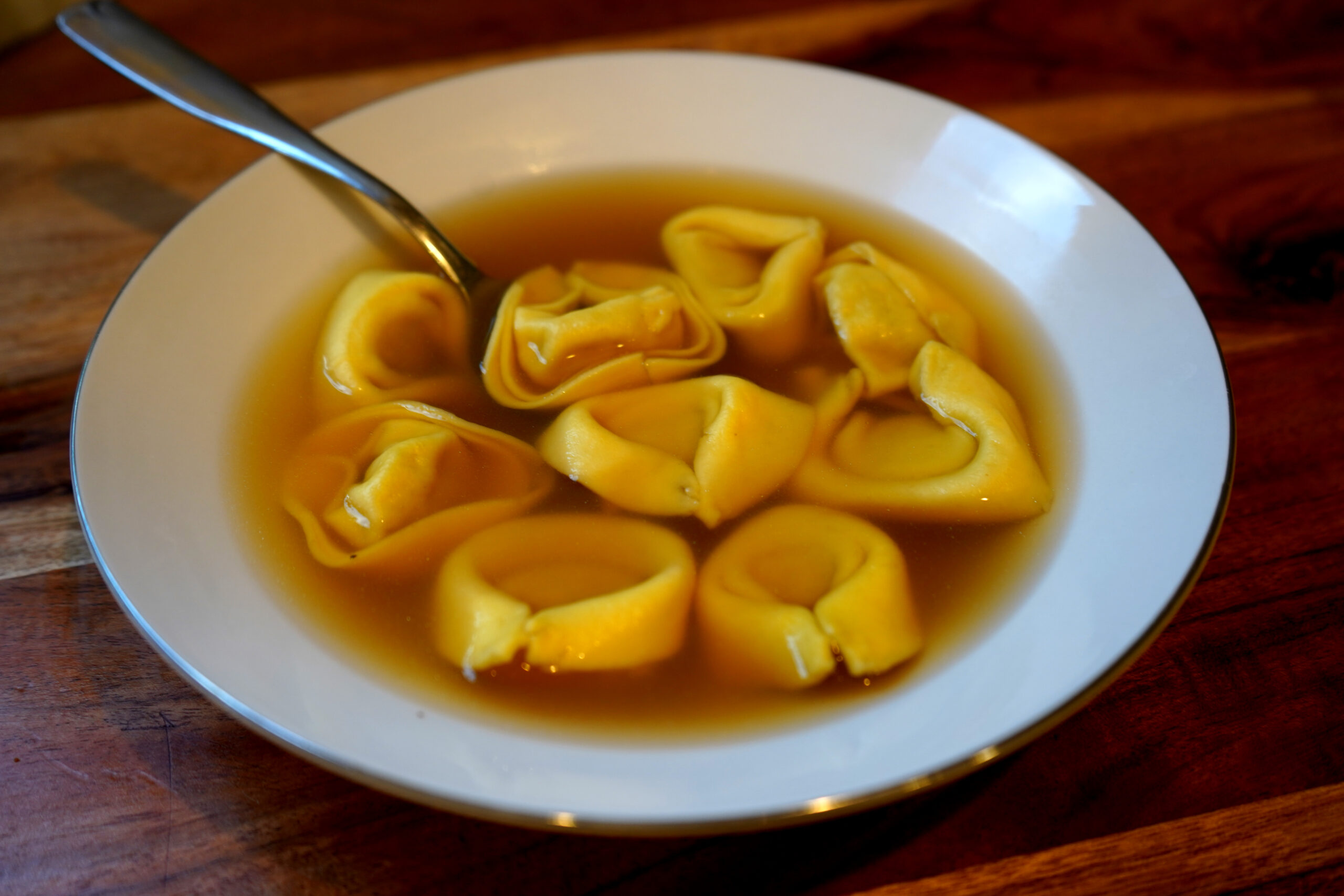
On Christmas Day in Emilia-Romagna, the meal almost always begins the same way: with steaming bowls of tortellini in brodo. The clinking of spoons on porcelain bowls is as much a part of the holiday soundtrack as church bells ringing or the crinkle of wrapping paper being torn open by impatient hands. And for just a moment, the table grows quiet. Everyone leans in, spoon in hand, ready to taste the first course that has been hours—sometimes days—in the making.
The Legend Behind Tortellini in Brodo
Legend has it that tortellini were inspired by Venus herself. Yes, that Venus—the goddess of love, beauty, and apparently pasta. The story goes that an innkeeper once caught a glimpse of her through a keyhole. He was so struck by her beauty that he rushed to the kitchen and tried to capture the curve of her navel in pasta dough. The result? Tortellini. Can you imagine if he had seen her elbow instead? We’d be sitting down to a very different Christmas.
Bologna and Modena, two culinary powerhouses in Emilia-Romagna, have spent centuries squabbling over which city invented the dish. Each claims the title like two kids tugging at the same present. To settle the matter, the Italian Chamber of Commerce actually filed a recipe in 1974, officially registering the “classic” filling of pork loin, prosciutto, mortadella, Parmigiano-Reggiano, egg, and nutmeg. Think about that: Italians felt so strongly about tortellini that they notarized it. That’s commitment.
The Importance of Broth in Tortellini in Brodo
If tortellini are the jewels, then the broth is the velvet box that makes them shine. In Emilia-Romagna, the broth isn’t an afterthought. It’s carefully coaxed into being over hours with beef, chicken, or capon, plus the holy trinity of onion, carrot, and celery. Sometimes a Parmigiano rind sneaks in, because waste not.
The broth does the heavy lifting. It’s what transforms these delicate little dumplings into a bowl that warms the soul. Too salty, and you’ve ruined Christmas. Too bland, and you’ve wasted three days of folding pasta. Get it just right, and you’ll see why Italians insist that the meal begin here—with simplicity, patience, and precision.
Flour: The Unsung Hero of Homemade Pasta
Behind every perfect tortellino is the flour. In Emilia-Romagna, most nonne (grandmothers) swear by tipo 00 flour—a finely milled Italian flour that creates a silky, supple dough easy to roll into paper-thin sheets. Some mix it with semolina flour, which gives the pasta a bit more bite and structure.
The choice of flour isn’t just tradition—it’s science. Tipo 00 creates a smooth dough that won’t tear when you’re folding those tiny belly-button shapes, while semolina adds durability so they hold up in the broth without dissolving. If you’ve ever wondered why homemade tortellini taste so different from store-bought, flour quality is one big reason.
The Health Benefits of Making Your Own Pasta
Sure, tortellini are a holiday indulgence, but making your own pasta comes with surprising health perks:
- Cleaner Ingredients: When you make pasta at home, you control what goes in—just flour, eggs, and maybe a pinch of salt. No preservatives or additives hiding in the dough.
- Higher Nutrient Value: Fresh eggs and good-quality flour provide protein, vitamins, and minerals that packaged versions often lose during processing.
- Better Digestibility: Freshly made pasta tends to be easier on the stomach than mass-produced pasta, especially if you use organic flour or blend in whole grains.
- Portion Mindfulness: Making tortellini by hand is labor-intensive, which naturally slows down eating and encourages savoring smaller portions. Italians understand this balance well—it’s not just about eating, it’s about enjoying.
So while tortellini in brodo may feel like a treat, it’s also rooted in wholesome, real ingredients that fit beautifully into the Mediterranean approach to food: balance, simplicity, and quality over quantity.
Family and Ritual Around Tortellini in Brodo
Now, making tortellini is not a solo sport. It’s an event. Picture this: Nonna rolls the dough so thin you can practically see the table through it. Aunt Lucia drops little dollops of filling with a spoon. Cousin Marco tries to help but folds them wrong and gets banished to dish duty. The kitchen becomes a factory line powered by laughter, gossip, and maybe a splash of Lambrusco. Each tortellino is folded by hand into that iconic belly-button shape. Tiny, delicate, and absolutely backbreaking if you’re the one doing it for hours. Italians will tell you there’s no shortcut.
Unlike the heft of a roast or the richness of a lasagna, tortellini in brodo is elegant and soothing—warming without weighing you down. It prepares you for the feast to follow, which might include everything from roasted capon to panettone the size of a toddler. This first course sets the tone. It says: here is food made slowly, with care. It says: we don’t rush at Christmas. It says: family is everything, and food is how we show it.
Tortellini in Brodo as a Sacred Holiday Ritual
Sure, you could buy them pre-made, but that’s like showing up to Christmas Mass in flip-flops. Technically allowed, but frowned upon. And while the folding itself is laborious, it’s also where the memories get made. Stories get retold, family arguments resurface, and kids learn by watching—or stealing scraps of raw dough when they think no one’s looking. By the time the tray is full, the tortellini carry not just filling but the fingerprints of everyone in the family.
What fascinates me is how a bowl of soup can become sacred. Not in the church-incense way, though let’s be honest, a good Parmigiano is close to holy, but in the sense of ritual. The first spoonful is more than broth—it’s history, family, continuity. Maybe your Nonna made them. Maybe the recipe was scribbled on a flour-stained card that somehow survived wars, moves, and toddlers with crayons. To eat tortellini in brodo on Christmas Day is to eat memory itself. And isn’t that what holiday food is really about?
Why Tortellini in Brodo Matters
Whenever I travel through Italy, I notice that the meals that linger in my mind aren’t the flashy ones. It’s never the Michelin-star tasting menu with foams and tweezers. It’s the tortellini in brodo made by a grandmother whose hands know more than cookbooks ever will. And maybe that’s the real magic here. The dish itself is simple, even humble. But it represents everything Italians hold dear: patience, tradition, family, and of course, a little drama—because let’s not forget the Venus navel situation.
So if you ever find yourself in Emilia-Romagna at Christmastime, don’t skip the first course. Because in the end, tortellini in brodo isn’t just soup—it’s a love letter in liquid form.
Tortellini in Brodo
Ingredients
Method
- Place chicken, onion, carrots, celery, bay leaves, and water in a large pot.
- Bring to a boil, then reduce to a gentle simmer.
- Skim foam from the surface as it cooks.
- Simmer for 2–3 hours until rich and flavorful.
- Strain, discard solids, and season broth with salt. Keep warm.
- In a bowl, combine pork, prosciutto/mortadella, Parmigiano, egg, nutmeg, salt, and pepper.
- Mix until smooth and well combined. Set aside.
- On a clean surface, form a mound with flour and make a well in the center.
- Crack eggs into the well and whisk lightly with a fork.
- Gradually incorporate flour until dough forms.
- Knead for 8–10 minutes until smooth and elastic.
- Wrap in plastic and rest for 30 minutes.
- Roll out dough into thin sheets (pasta machine or rolling pin).
- Cut into 2-inch squares.
- Place a small dollop of filling in the center of each square.
- Fold diagonally into a triangle, press edges to seal.
- Wrap corners around your finger and pinch together to form the classic tortellini shape.
- Bring the broth to a gentle boil.
- Add tortellini and cook until they float to the top, about 3–4 minutes.
- Ladle into warm bowls, making sure each serving has plenty of broth and pasta.
- Serve immediately with extra Parmigiano-Reggiano on the side.
Notes
- Use high-quality store-bought tortellini if you don’t have time to make them by hand. The homemade broth is what makes this dish shine.
- Tortellini can be shaped and frozen in advance. Boil straight from frozen in hot broth when ready to serve.
- Some versions add a touch of beef to the filling or enrich the broth with capon.